Off-Grid Infrastructure
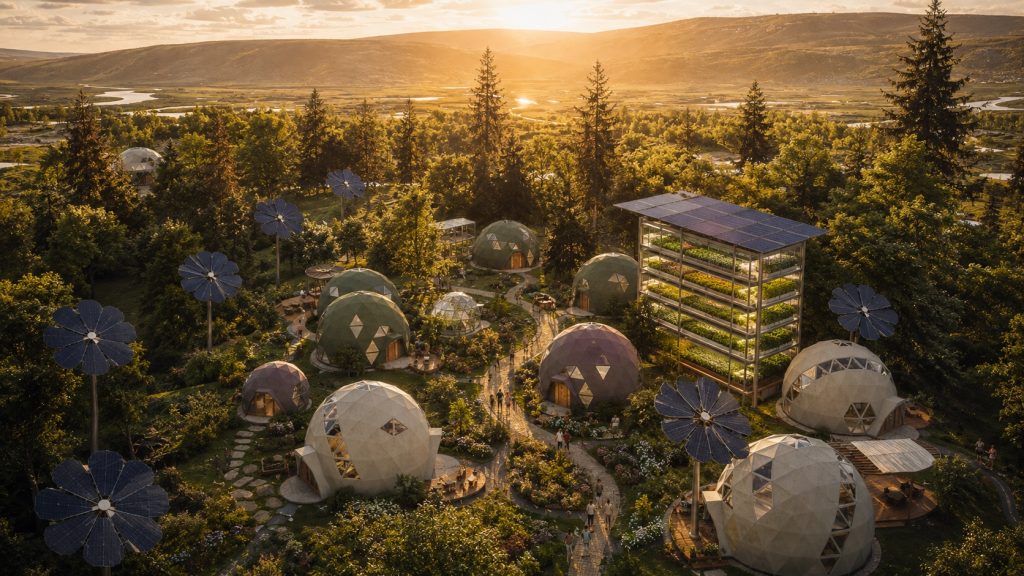
A resilient community produces its own energy and food, nurtures its water, turns waste into a resource, and shares its mobility.
Decentralized infrastructure is no longer the expensive option. Battery prices, solar output and off-grid appliances have all improved faster than utility rates, and in rural regions a self-reliant system is often cheaper than a grid connection. This is the checklist we walk through on every site, with the suppliers we trust.
Learn and build the essentials
Every resilient community stands on the same five systems: energy, food, water, waste and of course housing. On the energy side that means solar, micro-hydro or wind matched to a battery bank and inverter, with a backup generator for the dark weeks of winter; in forested regions, a biomass boiler can heat a whole cluster of homes, and every EV in the village can double as storage. Water means a reliable source, a way to heat it, and a plan for where it goes afterwards. Waste means composting or incinerating toilets and a greywater system, which together remove the need for a costly septic field on many sites; food scraps and farm waste can even feed a small biogas digester, turning waste back into energy. Housing is the shell that ties it all together, and we cover it in depth on our Housing Innovation page. In cold rural climates, heat deserves its own line: a wood stove, heat pump or ground-source geoexchange system sized for the coldest week of the year, plus efficient DC or propane appliances so your batteries last the night.
Our first call for all of it is Canadian Off Grid, a family-run Canadian supplier with showrooms. They carry complete power kits, batteries, inverters, toilets, greywater systems, water heaters and off-grid appliances, and they help with sizing and compatibility before and after the sale.
For more products and ideas, The Cabin Depot has been outfitting Canadian off-grid properties since 2013 and tests everything they sell at their own off-grid head office. For open-source designs and the deeper theory behind self-reliant villages, One Community Global publishes free blueprints for housing, energy, food and water systems.
Power and water keep a community running; food and mobility make it thrive. See our Food Tech page for four-season greenhouses, vertical farms and farm robotics, and our Electric Vehicles page for shared EVs, e-bikes and two-way charging.
Connectivity. An off-grid village can’t be offline. Starlink or fixed wireless brings the internet, and a simple layer of sensors on your batteries, water tanks and greenhouse lets the whole system run itself and warn you before something fails. This is also the foundation for the software and digital twins we’re building into our village designs.
Scale it as a community. One shared microgrid, well system and waste plan costs far less per home than ten separate ones, and it’s where the resilience really comes from. Sizing these systems at the village scale is the core of what we do, from a three-home co-ownership to a 150-person village.
Money and rules. Solar, batteries and heat pumps qualify for rebates and financing in most provinces, and the programs change yearly, so check before you buy. Electrical, gas and septic work needs licensed pros and permits; a system that isn’t to code can’t be insured or financed. We help groups navigate both.
Planning an off-grid site or community? Email jam@smartvillage.ca or book a call at cal.com/futurevillages.


