Four weeks. Three countries. 2 flights and many trains + bikes. A thousand quiet confirmations that the world we’re building already exists in fragments, waiting to be connected. All the photos are here!
Jean-Marc La Flamme
I left the Kootenays with two bags and a laptop full of AI dreams. I came home with something harder to name: a bone-deep confirmation that the regenerative world isn’t coming. It’s already here, scattered across alpine valleys and French watermills and Amsterdam industrial stages, waiting for someone to draw the lines between the dots.
Zurich: Where Climate Meets Capital
Intimate and interactive Climate Week
Climate Week Zurich is where builders go. I arrived with Geoship Homes in one hand and Future Villages in the other. Switzerland is a singular place to raise regenerative capital: old money, long time horizons, a cooperative tradition centuries deep, and investors who have already made peace with patient returns.
When you tell a Swiss impact investor about $600+ million in paid reservations for bioceramic geodesic homes, they don’t reach for skepticism. They request your LinkedIn. Conversations with dozens of impact investors confirmed a thesis I’d been building for years: regenerative communities are the next major real estate category, and the tools to develop them at scale now exist.
Roots: What the Old World Keeps
Canton Bern into Interlaken
Between conferences, I went home. The Swiss half of home.
I am Swiss-Canadian, which means I carry two kinds of knowing. The Canadian knowing is wide, young, and optimistic. The Swiss knowing is old and precise, forged by millennia of doing extraordinary things in brutal terrain alongside neighbours who speak four languages.
Switzerland gave the world the Red Cross, modern banking, direct democracy, and a neutrality that makes it the table where humanity negotiates when it can’t talk anywhere else. None of that came from abundance. It came from constraint. When the mountains will kill you if you’re not paying attention, you learn to collaborate or you die. The alpine communes were governing shared water rights through sophisticated democratic structures centuries before the modern nation-state existed. Cooperation wasn’t a Swiss virtue. It was a survival strategy that worked so well it became civilization.
Coming back recalibrates something that North American pace distorts. Quality outlasts speed. The long game is the only game worth playing.
That spirit is alive at Etherlaken, a regenerative innovation campus in Interlaken founded by Ralph Horat, nestled in the Bernese Oberland and asking a simple question: what if the place where people come to think and build was itself a working model of the world they’re trying to create? A few years into that partnership, this trip deepened it formally, focused on bringing the right events, investors, and innovators into that container. The Alps as backdrop. Regenerative infrastructure as the operating system.
Switzerland has the capital, governance depth, and cooperative tradition. Canada has the land, resources, and frontier energy. Etherlaken is where that translation happens in Europe. Future Villages is where it lands in Canada.
Val d’Hérens: Traditional Ski Villages
Arolla · Evolène · Valais, Switzerland
The villages of Evolène and Arolla didn’t grow around skiing. Skiing grew around them.
Dark timber, stone, mazots on mushroom caps keeping the rodents out: this is alpine architecture that solved its problems so completely it never needed to change. The wealth that built it came from cheese, the original Swiss engineering solution, turning summer pasture and impossible terrain into one of medieval Europe’s most tradeable commodities. Six hundred years of that logic is visible in every wall and waterway.
Skiing here is what it always was: a way to move through winter, not a lifestyle product. The mountain is not a resort. It’s a place people have lived and worked and buried their dead for centuries, and the lifts are almost incidental to that fact.
This is what regenerative development is trying to recover. Not the aesthetic, but the underlying intelligence: communities built around real life in real terrain, where the infrastructure serves the people and not the other way around.
Moulin d’Abondance: The Price of Beautiful Living
Haute-Savoie, Eastern France
Cross into France near the Swiss border and the land opens into something almost embarrassingly generous. The Moulin d’Abondance is a 200-year-old stone watermill: running water, year-round cellars, overproducing gardens, a village with a boulangerie and a weekly market. Total cost: a fraction of an equivalent property in coastal BC, let alone Zurich.
Eastern France, like rural BC and dozens of other forgotten regions, represents a genuine abundance arbitrage. Clean water, fertile land, intact community infrastructure, profound beauty, and prices that haven’t caught up to their actual value. The question isn’t whether these places are desirable. The question is how to connect the people who need them with the places that need people. That’s the core of what Future Villages does.
Cercle Paris: The Pulse That Connects Everything
Le Bourget · Paris Air and Space Museum
Cercle held their festival surrounded by actual spacecraft at Le Bourget, which turns out to be the perfect venue for what house music has always been trying to do: transcend the boundaries of where and who you are.
That’s the Cercle thesis. Find the most extraordinary locations on earth and let the music consecrate them. A concorde hangar. A clifftop. A medieval cloister. Stream it to everyone. No ticket required. No language needed.
House music was built for this. Born in the Black and queer communities of Chicago and Detroit, it spread across the entire planet through pure resonance, no marketing, no empire, just a pulse that every human nervous system already knows. Walk into a Cercle event and you’re standing with people from Lagos, São Paulo, Tokyo, and Tbilisi, same experience, same moment, no shared language required.
We are now transmitting that pulse into space. Literally and otherwise.
The right room turns a DJ set into something that feels unmistakably like church. Cercle knows this. The geodesic dome in the Kootenays is next on my list of venues worthy of the moment.
House music figured out what urban planners have struggled with for decades: belonging across difference, at scale, without coercion. The answer was always a shared pulse and a good room.
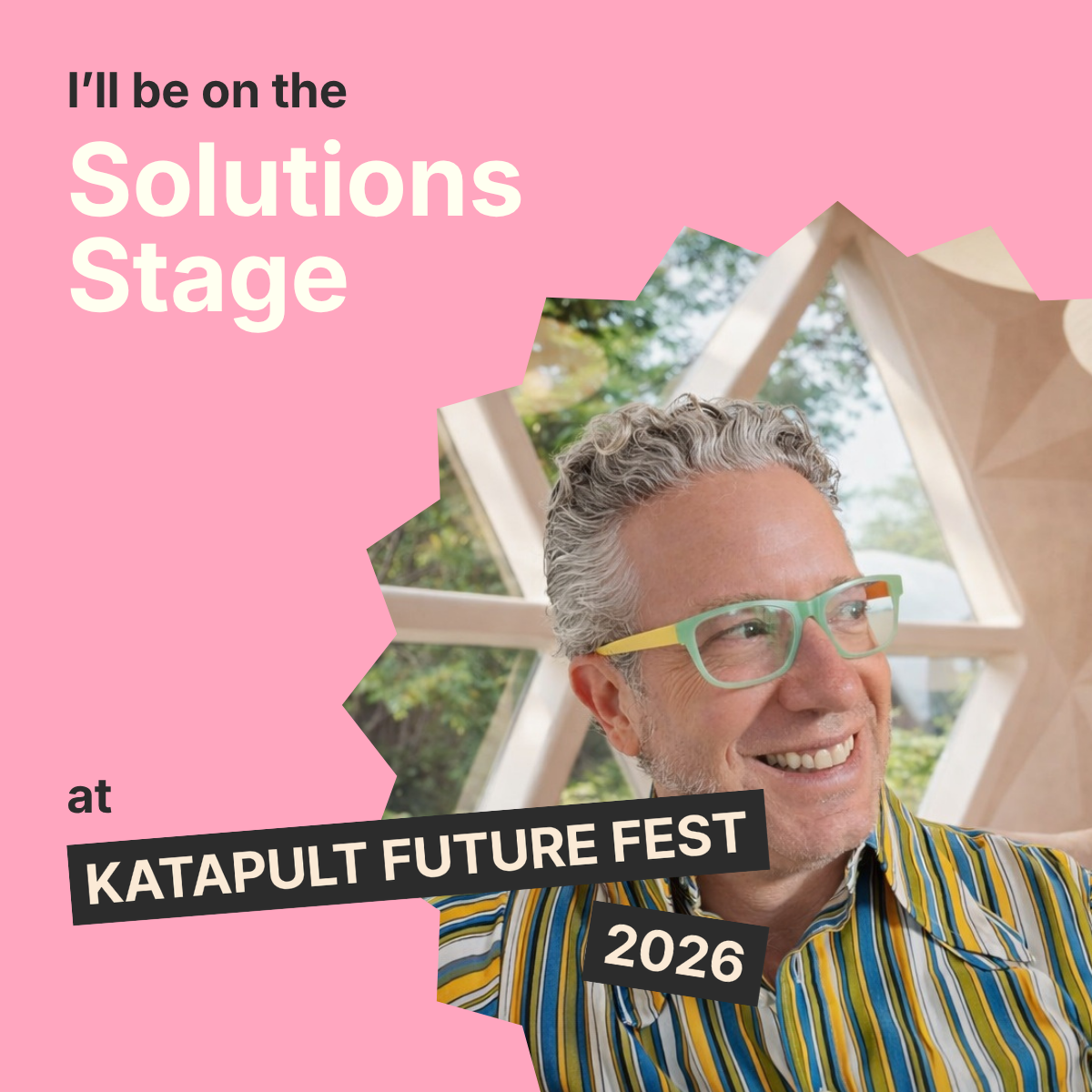
Katapult Future Fest: The Stage, the Platform, the People
Ruigoord Village · Amsterdam
Katapult is what happens when Scandinavian optimism, European impact capital, and genuine intellectual diversity converge in an Amsterdam warehouse and agree that building a better future is the only agenda. It works better than it should.
I came with a live co-creation platform built for the event. There’s a real difference between presenting a vision and demonstrating one. When the audience can touch it in real time, the conversation shifts from evaluation to co-creation.
The investor conversations were the most direct of the year. Not “is this real?” but “how do I get in?” The European regenerative finance ecosystem is ready. What it needs is the right vehicles and the right operators.
And then there were the people. I met Jason Silva, philosopher and filmmaker and one of the most eloquent voices alive on human potential. But he was one of hundreds. Katapult draws people who have already decided the future is worth fighting for and showed up to find their co-conspirators. I left with connections I expect to be building with for the rest of my life.
The Thread
Four weeks across three countries produces a compressive clarity. The Swiss cooperatives, the French ecovillages, the Amsterdam regens, the Kootenay communities, the bioceramic dome: all different expressions of the same question. What structures allow communities to thrive over time in relationship with the land they inhabit?
The old world has the answers. The new world has the tools: regenerative building technology, community trust structures, AI coordination platforms, and patient debt capital.
We don’t need to invent abundance. We need to stop building systems that prevent it. The work is already underway. We just need to connect it loudly enough that the people with the capital, the land, and the will can find each other.
That’s the trip. That’s the work. Let’s build it.

