Canada and most countries are spending billions trying to solve problems that regenerative communities solve by design.
We are spending $10 billion a year on homelessness. We are watching millions of Canadians describe themselves as chronically lonely, a condition researchers now compare to smoking 15 cigarettes a day in terms of mortality risk. We are building housing that is unaffordable using supply chains that buckle under every tariff, wildfire, and climate event that comes along.
And we are doing it all with centralized infrastructure (grids, pipes, roads, hospitals) that assumes permanent growth, permanent stability, and permanent fossil fuel inputs.
Regenerative communities are the architecture for a different assumption: that resilience, health, and affordability emerge from the bottom up, from the village scale, from people who live near each other and have real stakes in each other’s lives.
This is not a utopian idea. It is a design specification. And the evidence for it is now substantial.
What a Regenerative Community Actually Is
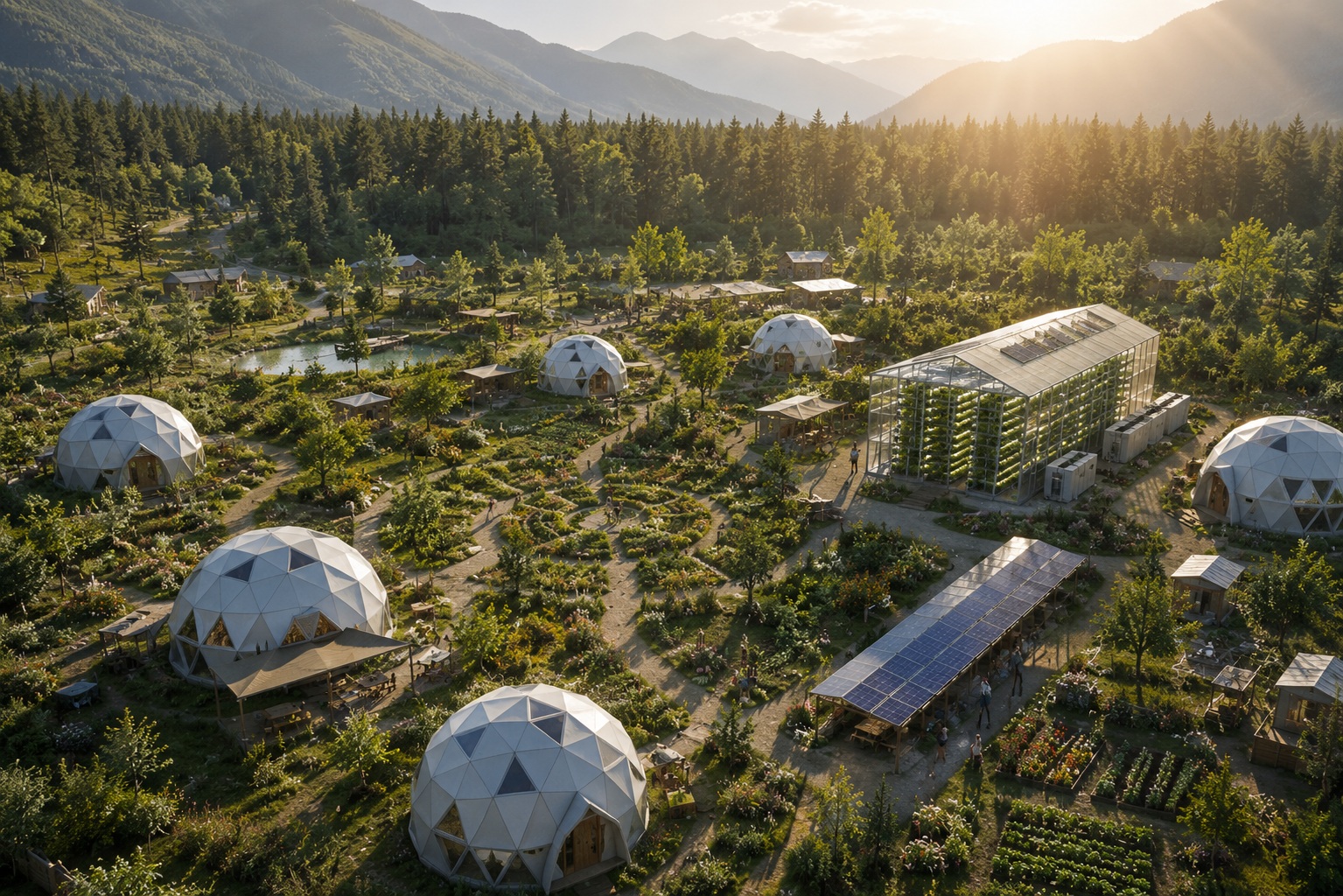
A regenerative community is deeply integrated in nature, anywhere from 20 to 500 people, designed from the ground up around five principles that conventional development ignores.
Shared land and cooperative ownership. Land is held in common through a community land trust, cooperative, or similar structure. Housing costs stay permanently affordable because the land is never resold at speculative market prices. Residents build equity in their homes without the land beneath them being extracted by capital.
Decentralized infrastructure. Power, water, heat, food, and waste are managed at the community scale using off-grid and distributed systems. No single point of failure. No utility bill that doubles when energy markets spike. No septic system that floods when the water table rises. The community generates more than it consumes and shares the surplus.
Regenerative food systems. Gardens, food forests, passive solar greenhouses, and vertical farms integrated into the physical design. Not an amenity but a function. Communities that grow food together build the social fabric and the ecological resilience that no amount of grocery store proximity can replicate.
Community-first design. First we listen to the land, working with ecologists, biologists, and real-time data alongside indigenous wisdom. Then we digitally model a community sized for the bioregion. Community is not an accident of proximity. It is engineered through shared spaces, shared governance, shared economy, and shared purpose. The Dunbar number, roughly 150 people, is the natural upper limit of a community where everyone knows everyone’s name. Regenerative communities are designed to stay within it, or to federate across it.
AI-assisted coordination. In 2026, the intelligence layer that makes all of this work at scale is becoming real. AI agents help understand environmental data, match skills to needs, manage shared resources, navigate permitting and funding, and connect to regional networks of similar communities. This is what Regen AI is being built to do, and what Future Villages is replicating as a global network.
The Metrics Nobody Is Talking About
The case for regenerative communities is not ideological. It is economic and medical.
On housing cost:
The average Canadian home now costs $713,000. Servicing that mortgage at current rates consumes more than 60% of median household income. Community land trust models cap housing cost at 30% of income permanently, not for the first buyer, but for every buyer in perpetuity. The land is never extracted. The affordability never erodes.
At the infrastructure level, a complete off-grid life support system for a household, covering power, water, heat, waste, and food storage, costs $50,000 to $100,000, installed once, with no ongoing utility bills. Shared across a 50-home community, the economics improve further through bulk purchasing, shared equipment, and distributed energy generation.
We have $25K prefab homes from China and Canadian prefab companies that can produce mass timber homes at $100K at scale.
On homelessness:
Canada spends approximately $10 billion per year managing homelessness: emergency shelters, healthcare, policing, and court systems. Annual healthcare costs for people experiencing homelessness are six times that of housed people, even after adjusting for health history. The federal government is spending $561 million per year on homelessness programs. Since 2018, the number of homeless people has increased 20%.
The system is not working because it addresses symptoms rather than causes. Regenerative communities built on cooperative land trusts remove the speculative pressure that produces homelessness in the first place. A unit of housing on a CLT cannot be financialized. It cannot be flipped. It cannot be left vacant. It permanently houses people.
On loneliness and mental health:
Among Canadians aged 50 and older, 40% are at risk of social isolation and 60% have experienced significant loneliness. Among those 65 and older, more than 40% report feeling isolated.
This is not a personal failing. It is an infrastructure problem. We built a country of single-family homes on cul-de-sacs, connected by cars, organized around workplaces rather than communities. We engineered loneliness into the physical fabric.
The health consequences are documented and severe. Research links chronic loneliness to increased risk of depression, anxiety, cognitive decline, cardiovascular disease, hypertension, and premature death. The mortality risk is equivalent to smoking 15 cigarettes a day.
Communities designed around proximity and shared daily life consistently show higher wellbeing outcomes than comparable populations. This shows up in reduced healthcare utilization, lower rates of depression, and longer life expectancy. These are measurable health outcomes at the population level.
On environmental impact:
A 2019 life cycle assessment of three ecovillages found their environmental impact ranged from 50% to 80% lower than the US average, with an average reduction in global warming potential of 67%. A study of 23 ecovillages and cohousing initiatives found that most achieved an ecological footprint around half that of comparable mainstream settlements.
A European survey found that if just 5% of the population engaged in community-level climate mitigation, the carbon savings would be sufficient to achieve 85% of the 2020 EU carbon reduction targets.
Not 50%. Not a wholesale economic transformation. Five percent.
What 1,000 Regenerative Communities Would Do for Canada
Canada has 38 million people. It has 3,500 municipalities. Most of its rural communities are underpopulated, aging, and underserved by infrastructure that costs more to maintain than the tax base can support.
The math of 1,000 regenerative communities at 150 residents each: 150,000 Canadians in permanently affordable housing, with decentralized infrastructure, local food production, and genuine social fabric.
That is a direct intervention into the loneliness epidemic for 150,000 people, at a fraction of the healthcare cost of managing the downstream consequences of isolation.
That is 150,000 households removed from the speculative housing market, reducing demand pressure in the cities they would otherwise be competing in.
That is 1,000 nodes of climate resilience distributed across the country, communities that stay functional when the grid goes down, when wildfire smoke grounds flights, when supply chains break.
That is an agricultural network producing meaningful food sovereignty for its members, reducing food import dependence, and building regional food systems that urban supply chains cannot disrupt.
And at 67% average carbon footprint reduction compared to conventional households, 150,000 regenerative community residents would produce the same emissions-reduction impact as removing roughly 100,000 conventional households from the grid entirely.
The Economic Return by 2030
Here is what happens when 150,000 people move into $100,000 homes instead of $713,000 ones, in communities designed to eliminate the costs that extract wealth from ordinary families.
At an average household size of 2.5, that is roughly 60,000 households. The savings per household compared to the Canadian average are not marginal. They are structural.
Mortgage debt avoided: $37 billion. Each household carries $613,000 less in debt than the national average. At current rates, that translates to roughly $30,000 per year in avoided interest payments, money that currently flows to banks and investor capital, and instead stays in the community. Collectively, 60,000 households redirect $1.8 billion per year back into local economies.
Utility bills eliminated: $210 million per year. Off-grid infrastructure means no monthly power, gas, or water bills. At the Canadian average of roughly $3,500 per household per year, 60,000 households eliminate that cost entirely. That money does not leave the community.
Transportation costs reduced: $336 million per year. Walkable design and shared mobility reduce car dependency. A 40% reduction on the average Canadian household transportation cost of $14,000 per year releases $336 million annually that currently flows to oil companies, insurers, and automakers.
Healthcare costs reduced: $120 million per year. Addressing social isolation for 150,000 people through the community design that proximity creates reduces healthcare utilization. Even a conservative 10% reduction on Canada’s average healthcare cost of $8,000 per person per year yields $120 million annually in avoided system burden.
Homelessness costs avoided: $1 billion per year. If CLT housing prevents just 10,000 people from cycling through the homelessness system, including shelters, emergency healthcare, and courts, at the documented cost of $100,000 per person per year, the annual saving is $1 billion.
Total annual economic return: approximately $3.5 billion per year by 2030, compounding as more communities come online, and as the avoided costs of climate damage, healthcare, and infrastructure failure accumulate.
This is not charity. It is not ideology. It is a better capital allocation. Every dollar invested in a regenerative community returns multiples to the public system and keeps circulating locally rather than leaking to distant corporations and creditors.
The village is not just a place to live. It is a financial instrument for community wealth.
This Is Already Happening
The global ecovillage network now counts more than 10,000 regenerative communities worldwide.
In British Columbia, the Kootenays are one of the densest concentrations of housing innovation and community development in Canada. In Kaslo we are undertaking a large-scale living lab, an off-grid infrastructure network, a regional AI platform, and a cooperative events economy, all built simultaneously from the community up.
Future Villages is scaling this model as a global circuit, connecting regenerative community developers, investors, and residents across North America, Europe, and beyond.
The tools are here. The housing products are available. The off-grid infrastructure is mature and affordable. The cooperative land models are proven. The AI coordination layer is being built.
The question is not whether this works. The research answers that.
The question is how fast we choose to build it.
Go Deeper With AI
The button below opens an AI to get you into regenerative community resources. Ask it anything: how projects are financed, what land models exist, which communities are active, what off-grid infrastructure costs, and how the economics actually work.
Want to go deeper? Ask Claude.
Get a current overview of global projects, housing costs, off-grid infrastructure, and land ownership models, answered in real time.
Ask Claude about regenerative communities →Opens Claude AI. Free to use.
Jean-Marc La Flamme is a regenerative community developer based in Kaslo, BC, Co-owner at Geoship, and founder of Future Villages. Reach him at jam@smartvillage.ca

