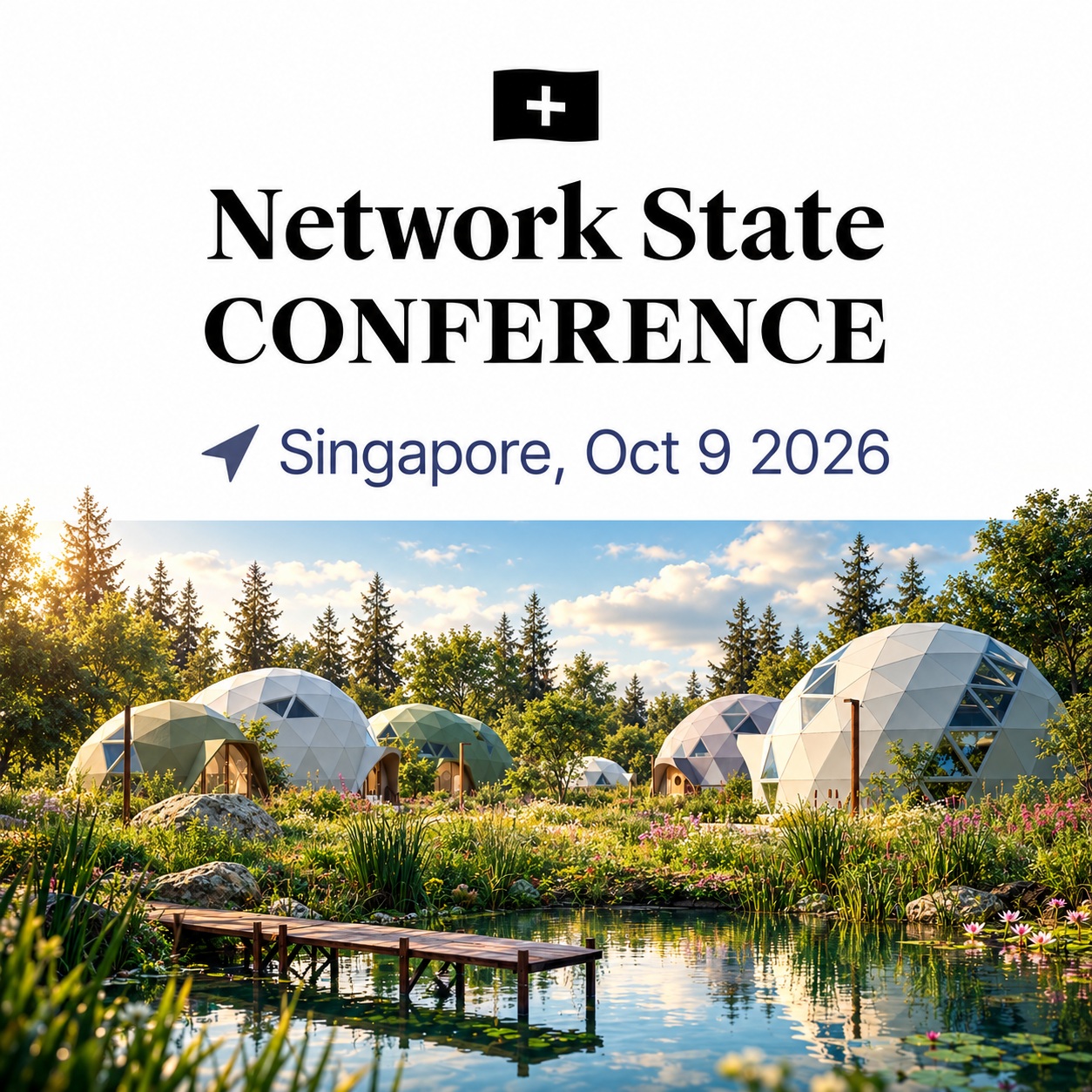
The Network State Conference 2026 in Singapore gathered the most ambitious group of startup society builders on the planet. Nine organizations presented projects spanning four continents, from 100-household family networks in rural America to 2,000-person innovation campuses in China to government-backed startup cities in Central Asia.
Watching the presentations, one pattern kept surfacing.
Every group had solved the same three problems: governance architecture, initial capital formation, and talent aggregation. The founders were technically sophisticated, philosophically grounded, and credible enough to attract early members and serious funding.
Every group was still searching for the same missing piece: the physical layer. Food sovereignty. Water independence. Energy resilience. Land models that cannot be captured by speculation or expropriation.
The regenerative community movement has been solving that missing piece for sixty years. The two movements have never seriously talked to each other. That is the conversation worth having now.
Who Was in the Room
RidgeRunner Five rural communities, 100 households, designed for families rather than founders. The unit economics work without crypto. The scale is human. The vision is a replicable template for family-centered intentional community that can franchise across North America without losing coherence.
Edge City operates at the opposite end of the spectrum: pop-up cities that graduate into permanent ones. Their Esmeralda community in California and a Bhutan project show two very different host contexts, but the same playbook: convene technical talent, create density, let governance and culture crystallize from there. At the conference, Edge City announced plans to raise Edge Ventures, a dedicated fund building on two and a half years of angel investing in the startup society ecosystem. The permanence question now has capital behind it.
Ipê City in Brazil has the largest physical footprint: 600 participants, a working campus, and the most explicit regenerative design language of any Network State project. Food systems, ecological restoration, and community governance are already integrated into their model. They are the clearest example of what convergence looks like in practice.
Ârc is operating in Sri Lanka with a Bitcoin Special Economic Zone structure. The governance is sophisticated. The geographic and legal context is genuinely novel. The ecological infrastructure question is largely unaddressed, which is a gap worth naming.
The Mu is the most surprising project in the cohort: 2,000 attendees at their founding event in China, operating inside a regulatory context that would seem to make startup society experiments impossible. The scale of early engagement is remarkable. Their ecological model is still being designed.
4Seas is explicitly multi-sector, connecting startup societies with traditional industries, investors, and municipal governments. Less a community project than a coordination layer across the broader movement. That role matters.
Noma Collective has a three-tier membership structure (digital, nomadic, rooted) that maps well to the lifecycle of how people actually commit to intentional community. Most communities fail because they expect permanent commitment before trust is built. Noma’s architecture acknowledges that.
Param is working at the citizen-innovator scale, routing talent toward civic problems rather than building a physical community. A different model with real overlap with the coordination work happening in places like the Kootenays.
CIHS (Centre for Integrated and Holistic Studies), the most understated project, is designed to be deleted. It exists to accelerate the broader ecosystem and then hand off. The volunteer movement framing is a refreshing counter to the founder-centric narratives everywhere else.
Beyond the nine presenters: Kazakhstan has partnered with Balaji Srinivasan on a startup city initiative through Alatau City with genuine government backing. That is the largest signal yet that the network state concept has moved from theoretical to negotiated.
What the Pattern Shows
Across all nine groups, the same assets are present:
Governance architecture. Every group has thought seriously about how decisions get made, how membership works, and how the community relationship with host governments is structured. The quality of governance thinking in this cohort is higher than in most municipal governments.
Capital formation. Token structures, investment rounds, family office backing, SEZ frameworks, and government partnerships are all represented. The movement knows how to raise money.
Talent aggregation. These are technically sophisticated early members. Engineers, designers, lawyers, founders. The social graph is dense and global.
What is systematically missing:
Ecological competence. With the partial exception of Ipê City, none of these projects have deep expertise in food production, water harvesting, soil restoration, energy independence, or the physical infrastructure of genuine self-sufficiency. They have the digital layer. They are renting the physical layer from the existing system.
That is a vulnerability. A startup city on the grid, dependent on municipal water and external food supply, is not a startup city. It is a co-living space with better governance documentation.
What Each Movement Brings the Other
The regenerative community movement has spent sixty years solving the physical layer. Findhorn has been running a biological wastewater system and wind-powered grid since the 1980s. Vauban generates more energy than it consumes. Babcock Ranch ran through two Category 4 hurricanes without an outage. The Traditional Dream Factory in Portugal is sequestering carbon while building a working food forest. Agritopia has been profitable for twenty years on a for-profit agrihood model.
What the regenerative movement lacks is what the Network State cohort has built: sophisticated governance design, access to capital, and the ability to aggregate global talent quickly.
The synthesis is not complicated.
Network State projects bring the governance architecture, the capital raise, and the talent network. Regenerative communities bring the proven physical infrastructure models, the ecological knowledge base, and sixty years of learning what actually fails when communities try to feed themselves.
The result is startup cities that are genuinely self-sufficient, not just self-governing.
A Five-Step Convergence Model
The path from parallel movements to integrated projects follows a logical sequence.
Gather. Network State conferences, regenerative community festivals, and the growing overlap audience already share significant membership. The convening infrastructure exists.
Co-design. The digital design tools now available (AI-assisted site planning, parametric modelling, participatory budgeting platforms) make it possible to co-create physical community design with residents before the first shovel. This is the futurescaping step that neither movement has fully activated.
Build. Prefabricated mass timber, geodesic ceramic domes, modular off-grid systems, community land trusts. Every component of a fully integrated regenerative community can be sourced and shipped today. The hardware is not the bottleneck.
Connect. Network State projects are built to connect. Federated governance, token economies, cross-community coordination. That infrastructure, applied to regenerative communities, creates the network effect that no individual village achieves alone.
Replicate. The franchise model that RidgeRunner is pursuing explicitly and that most other groups are pursuing implicitly requires exactly the kind of proven physical template that the regenerative movement has spent decades refining.
The Kootenay Proof Point
In Kaslo, British Columbia, several of these threads are already converging.
The region has more regenerative infrastructure per capita than anywhere else in Canada: tiny home manufacturers, mass timber production, microhydro cooperatives, an active community land trust development, and a civic AI platform being built by a non-profit. The network state toolkit, applied here, would find the physical layer already in place.
Future Villages is building the coordination infrastructure to connect that physical layer with developers, investors, and residents across Canada. The model is not theoretical. The land is available. The products exist. The governance frameworks are being written.
What is missing is the same thing every project in Singapore said they were still looking for: the convergence point where governance, capital, talent, and ecology land on the same piece of ground at the same time.
That is the build.
Balaji Srinivasan wrote that the network state is “a highly aligned online community with a capacity for collective action that crowdfunds territory in the real world.” The regenerative community movement has been crowdfunding territory in the real world, without the online community layer, for sixty years.
The missing piece for both movements is each other.
Jean-Marc La Flamme is a regenerative community developer based in Kaslo, BC, Co-owner at Geoship, and founder of Future Villages. Reach him at jam@smartvillage.ca

