Housing used to be the thing you built so you could get on with your life. Now it is the thing your life gets built around. That flip did not happen by accident, and it will not be undone by accident either.
This post traces how we got here. Then it makes a claim that sounds too small for the size of the problem: the way back starts with events and AI. Stay with me.
Shelter Was Never Supposed to Be an Asset Class
For most of human history, land was held in common or worked by the people who lived on it. A home was a use value. You built it, you lived in it, it sheltered your family. Nobody expected it to outperform the stock market.
Three shifts changed that.
First, enclosure. Common land became private property. Access to a place to live became something you purchased from someone who got there first.
Second, the mortgage. The 20th century turned home purchase into a financial product. This looked like democratization, and for a few decades of rising wages it partly was. But it also did something quieter: it turned every home into collateral, and every household into a debt servicer.
Third, abstraction. Once currency detached from anything physical in the 1970s, money creation accelerated and that new money needed somewhere to land. It landed in real estate. Housing stopped being priced by what local wages could carry and started being priced by what global capital would pay to park itself somewhere safe.
The Result: Your Time Is the Product
Here is the part that matters. When shelter is priced by capital instead of wages, the gap gets paid in human time.
Thirty years of a working life servicing a mortgage. Two incomes where one used to be enough. The best hours of your best years converted into interest payments. That is not a housing market. That is a mechanism for capturing time.
And captured time has a downstream cost nobody puts on a balance sheet: it is the time we no longer spend on each other, on our watersheds, on our food systems, on our towns. The cost of living crisis is not just an affordability problem. It is an attention problem. Communities cannot regenerate what their people have no time to tend.
I wrote about the economic side of this in The Real Reason Your Startup and Community Is Struggling. This is the deeper layer underneath it.
You Cannot Out-Earn a Broken Model
The standard advice is to work harder inside the model. Earn more, save more, get on the ladder before it pulls up again.
But you cannot out-earn a system that reprices itself against whatever you earn. The only real move is to build a parallel model where the fundamentals of living cost dramatically less. Land held differently. Homes built differently. Food, energy, and mobility owned differently.
I know how that sounds. Every generation has its back-to-the-land dreamers, and most of those experiments failed. They failed for a specific reason, and it was almost never the land, the homes, or the money.
They failed at coordination. They failed at trust.
Why Events Come First
This is the counterintuitive part. If you want to rebuild the economics of a place, the first infrastructure you need is not housing. It is gathering.
Trust is not built in meetings. It is built in rooms with music, food, and a reason to talk to strangers. Every durable cooperative structure in history sat on top of a social fabric that was woven somewhere else first: the barn raising, the market day, the festival.
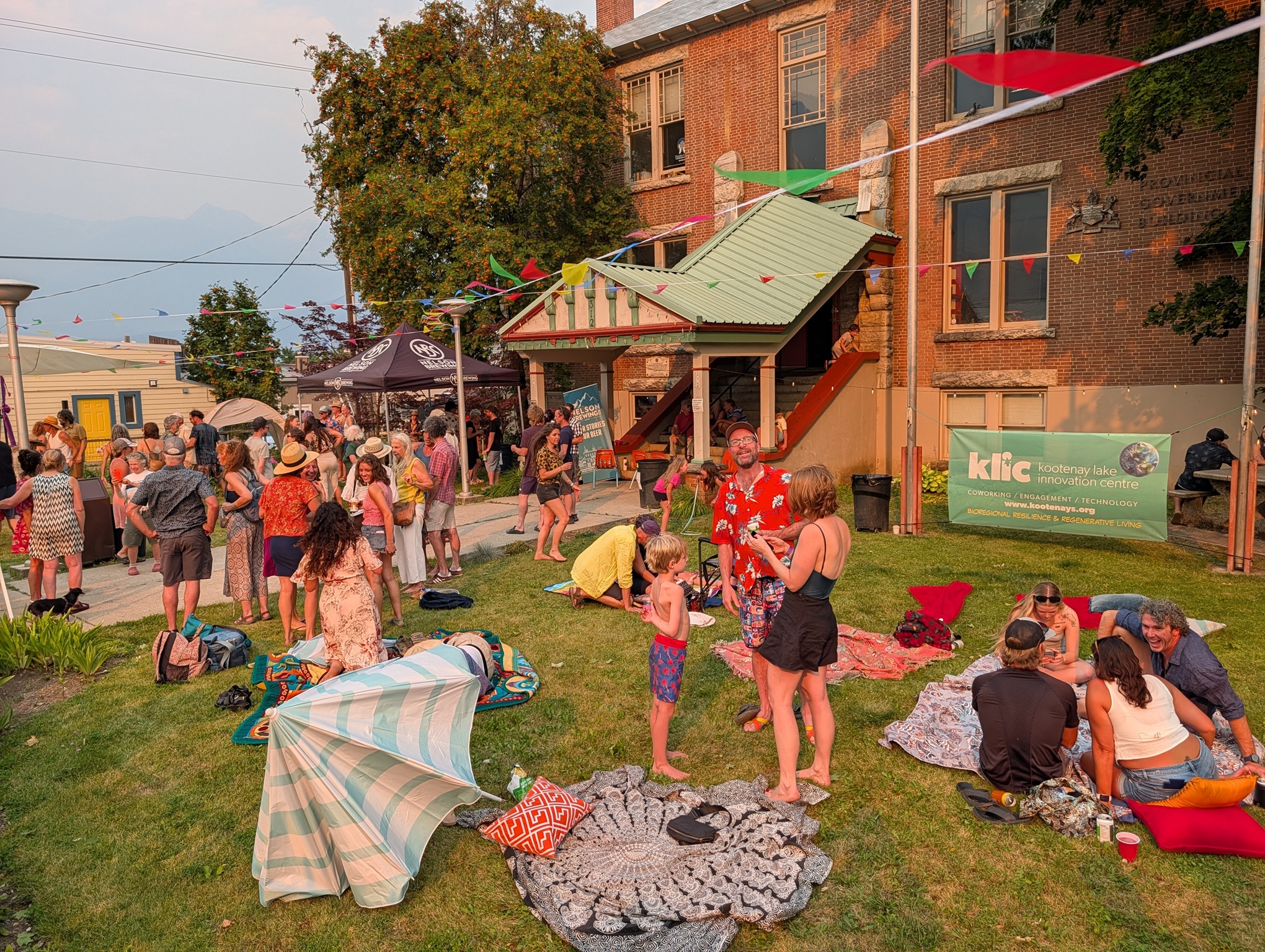
We just ran an experiment in this in my town of 1,300 people. A speed-connection festival where the entire design goal was collisions between neighbours who had never met. What came out of it was not entertainment. It was a map of who wants to build what with whom. That map is worth more than any feasibility study.
Events are civic infrastructure. They are the discovery layer for everything a community might do next. Small towns that treat their events calendar as decoration are sitting on their most undervalued asset.
Why AI Comes Second
The historic failure point of community-scale projects is what happens after the gathering. A hundred people leave inspired, then the follow-through dies in email threads and volunteer burnout.
This is exactly the gap AI closes. Not AI as a chatbot novelty. AI as a coordination layer: capturing what a community actually said, surfacing where consensus already exists, keeping a hundred threads moving when no human has the hours to do it.
And one more thing, maybe the most powerful: AI can now show a community its own future. Render two versions of the same block in 2030, one on the current trajectory and one on a regenerative one, and let people look at both. Abstract debates about zoning and trusts become a concrete choice between two pictures. Consensus forms around what people can see.
Events generate the trust and the signal. AI turns signal into coordinated action. Together they solve the exact problem that killed every previous attempt at doing this.
What Sits on Top
If a town gets those two layers working, a stack of other layers becomes possible: how land is held, how homes get built and at what price, how food and energy and mobility get owned. Each layer takes real cost out of a household’s life. Stacked together, they change what a life costs.
None of this is anti-capital. Capital still earns returns in this model, it just earns them from production, manufacturing, and infrastructure instead of scarcity!
I am not going to lay that stack out here. Partly because we are actively co-creating with it, and partly because the sequence matters more than the blueprint. Start with the gathering. Add the intelligence. The rest becomes buildable.
The abundance everyone keeps promising will not arrive from the top down. It gets assembled town by town, by people who have met each other and have the tools to act on it.
Building This Somewhere?
If you are working on events as infrastructure, civic AI, or the layers above them in your own community, I want to see your experiments in action and you can hear about our movement. Reach out at jam@smartvillage.ca

